Saturday, February 20, 2016

BONE METASTASES

Bone  Metastases


     Preoperative  transarterial embolization of hypervascular bone metastases, most commonly  renal metastases, is a very useful and helps reduce  preoperative blood loss and surgical morbidity. As a technique this was first  described  by Feldman et al and there have been a number of subsequent studies with favorable results . Barton et al reported 500-1500 ml intraoperative estimated blood loss (EBL) in embolized patients as compared to 2000-18500 ml if no embolization was performed . Further, even  partial devascularization of the lesion is beneficial in reducing estimated  blood loss although complete  devascularization is ideal.

     Tumor  vessels can originate  directly from a main artery or from distal  2nd or 3rd order branches. Embolization of the  former carries a higher risk of embolising down the main artery and the latter comes with cannulation  problems with smaller calibre arterial branches. Successful cannulation of the smaller branches gives the freedom  of aggressive embolization whilst proximal tumor  branches require extra care.

     The technique involves vascular access via a suitable artery depending on the tumor location.  Initual angiography  should include detailed  demonstration of all  the feeding branches. The tumor  arteries should be cannulated and  catheter positioned beyond any major  arterial branches. Embolization is usually performed using polyvinyl alcohol (PVA)  particles. The particle size should be appropriate to the size of the arterial branches embolised. Other  agents including  gelatine  sponge and coils have been  used.


      Transarterial  embolization of bone tumors is usually  safe with a few potential  complications. Post  embolization syndrome is not unusual  and should be considered for  planning  both the embolization and the surgical procedure. A number of these  bone lesions involve  the appendicular  skeleton and  hence embolization down the femoral or brachial arteries can result in ischemic  symptoms. Similarly   skin necrosis  and nerve palsies have been reported.

DNA METHYLATION AND EPIGENETIC GENE SILENCING

DNA  METHYLATION AND EPIGENETIC GENE SILENCING


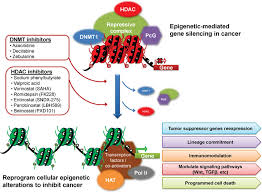
     DNA methylation is a reversible chemical modification of the cytosine in the CpG islands  of promoter sequences, catalyzed by a family of DNA methyltransferases. DNA  methylation does not change  the genetic information but it just alters the readability of the DNA  and results  in the  inactivation of gene by  subsequent transcript repression.  CpG island  are the regions  in DNA  that  contains  many adjacent cytosine and guanine nucleotides. The ''p '' in CpG  refers to the phosphodiester bond between  the cytosine   and  the guanine. These islands  occur  in  approximately  40% of the promoters  of human  genes. These  islands occur  in approximately 40%  of the promoters  of human genes. DNA methylation  plays  a critical  role in the control  of cellular  process  including  embryonic development , transcription, X- chromosome inactivation and  genomic imprinting. DNA  methylation occurs in the C5 positions of cytosines that precedes guanines and  are called dinucleotide CpGs. The CpG dinucleotides are not found frequently throughout the human genome and present 20 % of its  expected frequency. But approximately half of the human gene promoter regions have CpG rich areas of 0.5 to 2 kb in length. In which CpG
dinucleotide frequency are higher than expected . These CpG rich areas are often known  as CpG islands. . The majority (94%) of CpG island  remain  unmethylated  in normal cell. But particular subgroups of promoters CpG are  methylated  such as tissue  and germ line specific genes. In general , CpG  island methylation causes gene silencing. The  methylated CpG  island  also recruit   histone deacetylases  and other factor involved  in transcriptional silencing .  In activation  of tumor suppressor genes through  hypermethylation of CpG islands within promoters regions is a major event in carcinogenesis. Hypermethylation of CpG  islands within promoter regions  is a major  event in  carcinogenesis . Hypermethylation of CpG  island also has silencing effect on miRNA  in cancer. Micro RNA are short , 18-22  nucleotide, noncoding RNas that
regulate many cellular functions including cell proliferation, apoptosis and differentiation by silencing specific target  genes through translational repression or mrNa degradation.

COMPOSITE TISSUE ALLOTRANSPLANTATION

COMPOSITE  TISSUE  ALLOTRANSPLANTATION  


        After the report of the first microvascular tissue transfer  the free transfer of autologous tissue became the  mainstay for  treatment  of complex soft tissue defects and with reimplantation  of the  hand and digits, the modern era of replantation in reconstructive  surgery began in the  1960.
    
        Composite tissue allotransplantation (CTA)  is a term that includes transplantation of multiple tissues of ecodermal and mesodermal  origin. It  involves simultaneous transplantation  of tissue  components  involving  skin, muscle, nerve bone and tendons. Transplantation of hand is one of the best examples of CTA concept and it has  brought the  attention  of the  scientific  community and the public  to this new field of transplantation. The growth of solid organ transplantation also parallels the emergence of newer immunosuppressive drugs.

       The first hand transplant was performed in Lyon France in 1998, with eventual graft loss due to noncompliance with immunosuppression. The clinicopathological  freatures of rejection were largely confined to skin with milder involvement of muscle   and tendon and sparing of bone and joints.

     Louisville School of Medicine  in United  States has taken lead  in hand transplant surgery in the United  States. Of the approximately 30 hand transplants done worldwide, 3 have been done in Louisville. A hand  transplant protocol by the University  was drawn up. Patient recruitment  is rigid. The transplant protocol by the University  was drawn up. Patient  recruitment  is rigid. the pretransplant  psychiatric evaluation  screening tests are similar to solid organ transplantation  and include routine  blood work out. ABO  type, cancel reactive antibody, infection screen , chest X-ray, cardiac evaluation, etc .

      Decreased donor has to meet the standard criteria for determination of brain death. Donation after cardiac death is not  considered. All donors were from the jurisdiction of the  local organ procurement organization. ABO blood group compatibility and a negative  crossmatch with the recipient was necessary. Absolute contraindications included active  intravenous drug use. A detailed evaluation of the limbs of the potential donors included range of motion in all joints and absence of arthritis.


     The details  of the donor procedure is described briefly. A circumferential incision is made around the  distal arm with identification of underlying  veins and cutaneous  nerves. another longitudinal incision is made along  the medical side of the arm over the brachial vessels  to enable cannulation for cold perfusion of the limb with the University of Wisconsin  solution.

        The sequency of tissue repair proceeds in the following order: bony fixation, arterial revascularization, vein repair, tendon repair and nerve  repair. All  patients  received  heparin for 48 hours postoperatively.

       Immunosuppression   was induced with basiliximab , tacrolims, MMF  and steroids, The digits were fixed in metacarpophalangeal  fiexion.  The   wrist was in a dynamic brace. a transcutaneous electrical  nerve stimulation unit to decrease pain and  electric muscle stimulator were  used throughout the rehabilitation course. Skin biopsies were performed to monitor rejection.

       In  Malaysis, an upper extremity transplantation was performed at the level of the shoulder on a 28 day old neonate  born with congential absence of one arm.  The identical  twin had fatal brain anomaly and was the donor of  the limb. The  transplanted limb grew at the same rate as the native limb and after 7 years was  functional. One major controversy surrounding CTA is the  toxicity of immunosuppression with an increased risk of cancer, organ failure and opportunistic infections.

      Many other tissues have been successfully transplanted to restore tissue loss from trauma or tumor. Simultaneous and sequential abdominal wall transplantation  coincident with intestinal transplantation has been reported from University of Miami. A 40- year- old man received the  first  successful human laryngeal transplant in 1998. A human leukocyte antigen matched  laryngopharyngeal complex including  thyroid,prathyroids and five rings of trachea were transplanted  along with   anastomosis of both superior and one of the recurrent laryngeal nerves.

       At a follow- up of more than 7 years, the patient had excellent  function, normal swallowing and good phonation. Other workers have reported 13 laryngeal transplantations with 90 percent graft survival at 2 years using immunosuppression similar to renal transplantation . Patients with  severe disfigurement of face not amenable to reconstruction are likely to benefit from partial face transplantation. The first  facial transplant was in a 38- year- old woman, disfigured by a severe dog bite who received a  central and lower  facial transplant in 2005.  A sentinel skin graft was placed in the left inframammary area to monitor rejection.  Sensitivity to  light touch and temperature returned by 6 months , whereas  motor recovery allowing complete mouth closure was achieved at 10 months . Despite two episodes of acute rejection and renal  dysfunction requiring cessation of tacrolimus, the patient is satisfied with aesthetic result and  is maintained on sirolimus, MMF and prednisone.

Wednesday, January 6, 2016

BASIC ACCOUNTING CONCEPTS

BASIC  ACCOUNTING  CONCEPTS

     Accounting  is based on certain assumptions.  These assumptions are known as basic  accounting  concepts. Those basic accounting concepts are as follows.


  • Business entity concept : This concept states that the business and its owners are two separate and  distinct  entities. According to this concept, all transactions of the business have to be accounted for from the viewpoint of the business and not from the view point of its owners. The distinction between the business  and its owners is essential in order to ascertain the true picture  of a business.  If the two are not  separated for accounting purposes, the transactions of the busiess will be mixed up with the personal  transactions of its owners  and the true picture of the business can not obtained.


  • Going  concern concept : This concept implies that a business has an indefinite life and it exists for a long period of  time. All business tranactions are performed and recorded from this point of view. The long- term expenditures such as the purchase of land, building and  machinery that the business makes are recorded  in books of  account assuming  that  it will exist and run for a long period  of time.  Their  costs and not the current resale values are recorded spreading over their estimated working  lives. Therefore, the balance sheet always shows fixed assets at cost after subtracting the depreciation.


  • Money measurement concept :  This concept assumes that only those business tranactions which are measured and expressed in monetary terms have to be taken into account. It is so assumed  because money provides a common measure for different goods, services, assets and  liabilities. This concept also assumes that  monetary units such as 'rupee' are stable units in value , but this assumption may not be  true in reality. Therefore, in spite of a decrease in the purchasing power of money, accounting  is performed assuming that the value of money is stable over time.


  • Accounting period concept : The accounting period concept implies that for the purpose of reporting financial information, the whole life of the  business is divided into imaginary  time- intervals. Each time interval is called  an accounting period which is normally  of one year. In Nepal, it begins on the 1st of Shrawn  every year and ends  on the last day of Asad the next year. At the end of each accounting  year, financial statements are drawn to ascertain the  profit  or loss and the financial position of the  business, and are reported  to their users such as owners, managers and creditors.

  • Revenue concept-This concept is also called realization concept. The concept states that revenue is assumed  to be earned when it is realized . According to the concept, revenue is realized when goods  are transferred to the buyers  and services are provided to the clients for  cash, or for assets or in  anticipation of  realizing the value of sales on a future date. It is not  necessary that the revenue must be realized in cash.  Besides , revenue is  earned in the period when it is realized. However, revenue  realized is always net  of goods returned from the customer  and bad debts.


  • Cost concept :  This concept implies that the cost of anything  such as a service or an asset is recognised when it is incurred and not when cash  is paid for it.  According to the concept, the  cost is assumed to be incurred when the service or the asset is used to generate  revenue .  Besides, the concept assumes that  the asset is taken into account at the cost of its purchase and not at its market value. This concept , however does not mean that the cost of purchase appears in the books every year. Since an asset  has a limited life, its cost  is written  off every year over its life. Thus, the books show the asset at the purchasing  cost less its depreciation up- to- date.


  • Matching concept: This concept provides guidelines as to how the profit or loss of a business should be determined. The  concept , therefore, states that  revenue earned in a period has to be matched with  the expenses incurred  in the same period so as to find  out the true  profit or loss  of the business. While matching the expenses with the revenue , the latter should be realized first and then only the expenses  relating to the revenue should be recognized . Any expense or revenue of the previous  or the next year  should not be matched with those of this  year. If they are matched, the true profit or loss can not be  ascertained.


Epigenetics and Cancer


Epigenetics and  Cancer


INTRODUCTION
  
        
         Epigenetics  is a rapidly evolving study of molecular genetics and biological research. The advancement in the understanding of different  biological activity like DNA methylation, chromatin structure, transcriptional  activity and histone modification has resulted in the development  of epigenetics. Epigenetics changes influence gene transcription  without alteration in the DNA  sequence. The term '' epigenetics was first used by Conrad  Waddington in 1939 to describe ' the causal interaction between the genes and their products, which bring  the phenotype into being.'' In  present  era the term  epigenetics has broadened to include heritable and  transient / reversible changes in gene expression that is not accompanied  by a change in the DNA  sequence. There are two type  of major of major  epigenetic  modification: those occurring  at the DNA level (DNA methylation) and  those occurring at the chromatin  level ( chromatin  remodeling). DNA  Methylation is an  enzyme driven chemical change to the DNA  sequence that most commonly occurs at CpG dinucleotides.  Chromatin remodeling  occurs via modification of the histone residues  by enzymes  primarily  on  the N- terminal  tails and ultimately effects  the interaction  of DNA  with chromatin modifying  proteins. Both DNA methylation and histone modification are associated with silencing critical  tumor suppressor genes and activating oncogones involved in cancer.


       Most  of the traditional  molecular studies on cancer are on identifying the genetic mutation or on tumor suppressor gene. Recently, more studies are now focused in discovering new biomarkers  that are epigenetically silenced in early carcinogenesis.  It  is also seen that almost half of the  tumor suppressor genes that  causes familial  cancer through mutations can  also get inactivated with  promoter hypermethylation  in sporadic  cancer. Increasing  evidence suggests  that epigenetic changes  play a key role in  cancer development.

          
          The various  genetic  markers has been used for the early  tumor detection, prognostic prediction and explaining  the genetic pathway of carcinogenesis. But the epigenetics marker has  gained popularity in recent year particularly the promoter hypermethylation which has various  advantages over  a genetic marker.  First promoter hypermethylation is  much more common than genetic alteration  in cancer.  Second promoter hypermethylation occur in the same defined region of that gene  in  all  form of cancer in comparison to wide  range of mutational  variations occur within a specific  gene. Thus epigenetic detection of promoter                                                                                             hypermethylation  will be both efficient and 
                                                                       cost- effective method of tumor detection.   


DNA METHYLATION AND EPIGENETIC GENE SILENCING

DNA  METHYLATION AND EPIGENETIC GENE SILENCING


     DNA methylation is a reversible chemical modification of the cytosine in the CpG islands  of promoter sequences, catalyzed by a family of DNA methyltransferases. DNA  methylation does not change  the genetic information but it just alters the readability of the DNA  and results  in the  inactivation of gene by  subsequent transcript repression.  CpG island  are the regions  in DNA  that  contains  many adjacent cytosine and guanine nucleotides. The ''p '' in CpG  refers to the phosphodiester bond between  the cytosine   and  the guanine. These islands  occur  in  approximately  40% of the promoters  of human  genes. These 
islands occur  in approximately 40%  of the promoters  of human genes. DNA methylation  plays  a critical  role in the control  of cellular  process  including  embryonic development , transcription, X- chromosome inactivation and  genomic imprinting. DNA  methylation occurs in the C5 positions of cytosines that precedes guanines and  are called dinucleotide CpGs. The CpG dinucleotides are not found frequently throughout the human genome and present 20 % of its  expected frequency. But approximately half of the human gene promoter regions have CpG rich areas of 0.5 to 2 kb in length. In which CpG dinucleotide frequency are higher than expected . These CpG rich areas are often known  as CpG islands. . The majority (94%) of CpG island  remain  unmethylated  in normal cell. But particular subgroups of promoters CpG are  methylated  such as tissue  and germ line specific genes. In general , CpG  island methylation causes gene silencing. The  methylated CpG  island  also recruit   histone deacetylases  and other factor involved  in
transcriptional silencing .  In activation  of tumor suppressor genes through  hypermethylation of CpG islands within promoters regions is a major event in carcinogenesis. Hypermethylation of CpG
  islands within promoter regions  is a major  event in  carcinogenesis . Hypermethylation of CpG  island also has silencing effect on miRNA  in cancer. Micro RNA are short , 18-22  nucleotide, noncoding RNas that regulate many cellular functions including cell proliferation, apoptosis and differentiation by silencing specific target  genes through translational repression or mrNa degradation.

Tuesday, December 1, 2015

Laparoscopic


          Laparoscopic   Management   OF   Large   Hiatus   Hernia

INTRODUCTION


   The Management of large hiatal hernias is difficult and their operative repair can be technically challenging . The concept of a large  hiatal  hernia, however, has not been clearly defined. They have been classified by various  authors according to whether the hiatal defect  is larger or  smaller  than 5 cm and or / or their  contents. Aly et al considered hiatal hernias to be large when more than 50 percent  of the stomach has migrated into the chest.  Andujar  defined  it as the presence  of more than one- third of the stomach in the thoracic cavity. Carlson et al in his study has  defined  hiatal  hernias to be large if the  hiatal defect is larger than 8 cm which was later  modified to 5-6 cm. We consider paraesophageal hernias to be large  when more than half of the stomach has migrated into the chest or if the hiatal defect is larger than 5 cm in size.
    
    Hiatal hernias are classified into type I to IV depending on the position of the gastroesophageal junction in relation to the diaphragmatic  hiatus. According to the conventional classification, type III and type IV can be considered to be large hernias. Type III hernias, which is a mixed sliding and paraesophageal hernia (PEH)  occurs predominantly in the elderly population . The end stage of a hiatus hernia  is an intrathoracic stomach in which the whole stomach  migrates into the chest by rotating 180 degrees along its longitudinal axis with the caedia and the pylorus as fixed points  and includes other organs including colon, omentum, small bowel , liver and spleen (TypeIV).
   
     Surgical correction of large hiatal hernias is indicated because of unsatisfactory outcomes after long- term medical  management and potentially disastrous consequences of gastric incarceration or volvulus  in large paraesophageal hernias. Fundamental steps involved in large hiatal hernia repair include a tension free reduction of the esophagus  and the stomach into the abdomen with complete excision of the hernial sac, reapproximation  of the hiatus, and subdiaphragmatic  fixation of the stomach, with many authors advocating the additional of an antireflux procedure.


     Recurrence rates after laparoscopic surgery is a controversial and unresolved  issue. A few early studies have shown alarmingly  high recurrence rates. Some possible patient related and procedure  related mechanisms are  in appropriate postoperative activity  of the patient immediately after surgery, inadequate excision of the sac, inadequate mobilization of the esophagus, inadequate crural closure secondary to widely spaced crura sutured  under  tension , or a postoperative rupture of crurorraphy due to continuous excursion of the diaphragm.
   
     After complete reduction of all the hernial contents, the necessity of complete excision  of the  hernial  sac cannot be understated. IN  earlier series recurrence rates of up to 20 percent have been  reported after inadequate excision  of the hernial  sac . Although  sac removal is tedious and difficult,it is one of the most  crucial  steps of large paraesophageal  hernia repair. If  circumferential  reduction of the sac  is not done and a portion  of the  sac of new  hernia formation has been  practically  left behind. Fluid collections in the unresected sac leading to postoprative dysphagia have also been reported in literature.
   
     A number  of methods have been adopted to reduce the risk of postoperative recurrences and include the use of Teflon pledgets to prevent crural sutures from cutting through, complete detachment of the sac from the hiatus and mediastinum, complete excision of the sac, adequate mobilization of the esophagus and use of mesh cruroplasty in patients with a large hiatus hernia to achieve a tension free hiatal.


SURGICAL PRINCIPLES


    Although the need for surgical repair is undebated, controversies exist concerning the best surgical  approach  whether open or laparoscopic, the presence of short esophagus and the need for an esophageal lengthening procedure, crurorraphy or a tension free mesh repair, subdiaphragmatic  fixation of the stomach , the need for an antireflux procedure, whether total or partial fundoplication and the indication for prosthetic  reinforcement of the hiatus.